Sue Larkey Blog
Helping you “Make a Difference”


Tips, Strategies, Time Savers and Inspiration to help make difference for a child with an ASD in your class, home or community.

Please join my Facebook Community as you also read the insights, ideas and support of many amazing teachers, parents and professionals. Click this Facebook Icon Facebook Icon(or google “Sue Larkey Teacher”)
Please comment on any Blog via my Facebook page.
To Tell or NOT to Tell, and WHAT to Tell?
To Tell or NOT to Tell, and WHAT to Tell? I regularly get asked whether students should be told they have Autism, Asperger’s, ADHD, etc. I believe telling children about their ASD helps them understand and actually increases their participation and engagement. “Until recently, much of the literature has focused on sharing the diagnosis with parents and carers. Relatively little attention has been given to explaining the diagnosis to the child. Accounts from adults with autism and Asperger Syndrome have suggested that being told their diagnosis is largely positive and beneficial. They report that this helps to make sense of themselves to understand the behaviour of others and enables them to develop strategies to manage situations they find problematic. Sharing the diagnosis also allows individuals to access relevant literature and to make contact with others with autism or Asperger Syndrome. Those who feel confident and positive about their diagnosis are likely to fare better than...

Using the Word STOP
Using the Word STOP What does STOP really mean? Being told to STOP can be very confusing for people with ASD. Many children with ASD, ODD have “Mind Blindness.” It means they often are literal, don’t know the inferred intent of language and have difficulty taking another’s perspective. This means the word STOP can be very confusing. For example if an adult says “STOP” do they mean stop breathing, stop looking, stop moving, etc. STOP does not tell a child what they can do – it only tells them what they shouldn’t do. When you have to use STOP make sure you add a little more information so that the child knows what they should do, e.g. “STOP! Hands down” if he is about to reach for something on the stove or “STOP. Feet still” when he is about to run onto the road or “STOP, pencil down time to listen.” Although these instructions sound a little overdirected they clearly convey the intended message to the child. It is important children know what the STOP word means and to respond...
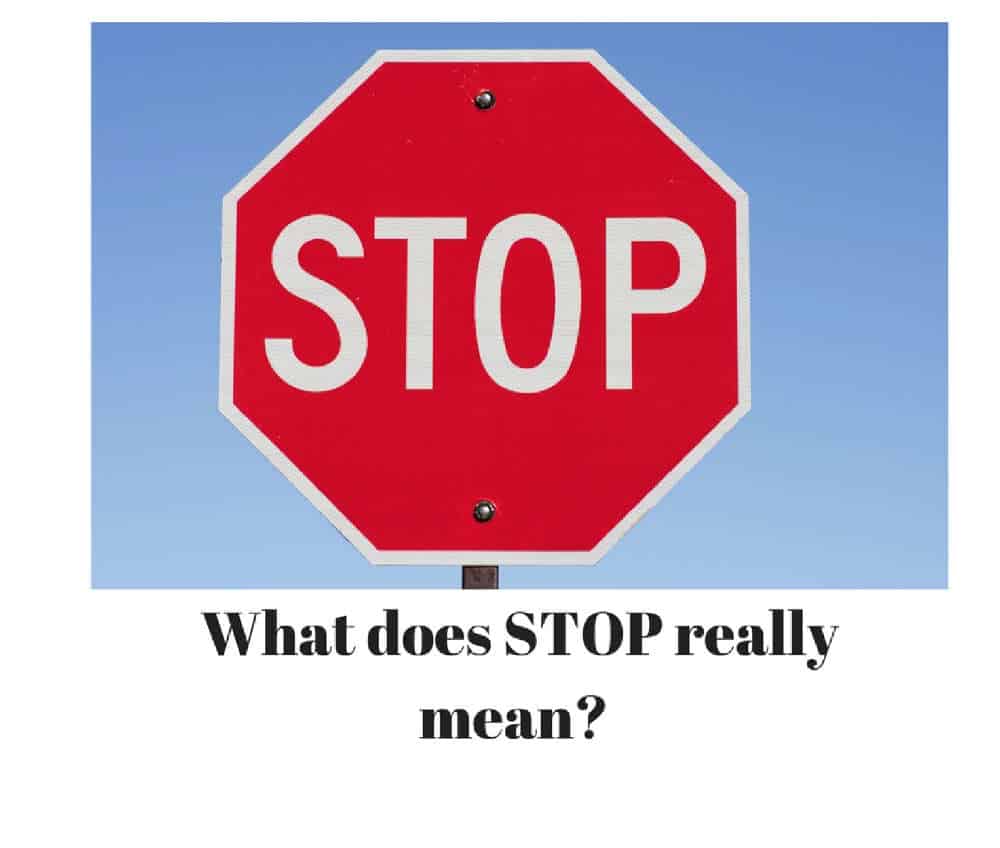
Photo Cookbooks and Life Skills
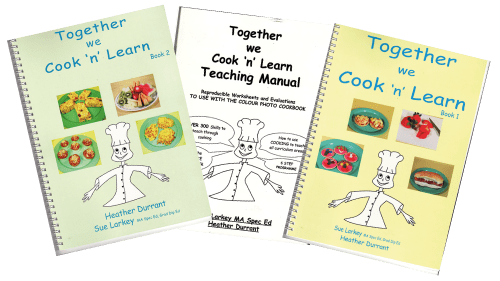
Photo Cookbooks and Life Skills Cooking! Using Cooking to Teach Everything! Life Skills, Social Skills, Maths, Science, English and more! (See my Cook Books page for Books and CD’s available) Cooking is a daily activity for everyone. It is a wonderful activity to teach ALL ages and stages. Cooking is an activity families, schools, community groups – indeed anyone can do it – and it provides long term recreation and independent living skills. Through cooking you can teach all curriculum areas (see below). By providing a structured programme with goals/learning outcomes you can develop a cooking programme that addresses the learning style and needs of the individual student. One child may use the programme to learn to read while another may use it to communicate, using visuals. 5 Ways to Use Cooking to Teach Here are some examples of how cooking can be used to teach a wide range of skills at both school and home: Sequencing: Cut up recipes and get the child to put in the correct...
Developing a Good Relationship between Home and School
In my experience successful education for a child on the autism spectrum starts with a positive working relationship between home and school. One of the biggest challenges for parents/carers and teachers is to develop an effective relationship. It is in the interest of everyone involved child, staff and families that we create a positive partnership. This is created by: Team Work 1. Team work is the key to achieving desired outcomes. We are all on the same side. We all have the best interest of the child at heart. When we have the attitude that we are all on the same team, the child’s team we view everything differently. 2. Share information, brainstorm ideas and learn together. 3. Ask questions. You should never be ashamed to ask questions – we are all there to help the child through life. 4. Brain storm ideas. Remember not every strategy works for every child so it is good to have a few ideas to try. **Sign up at the bottom of this page to instantly access the rest of these...

Fidget Spinners – To Use or NOT to use?
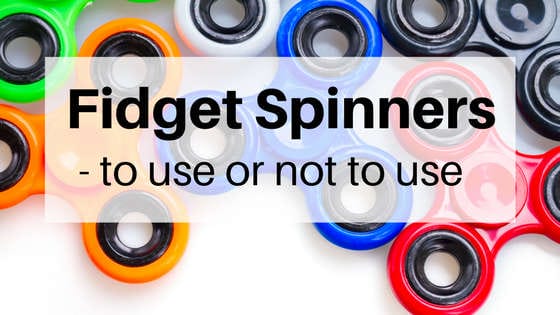
In is you will learn: 1. What is the Goal of a Fidget Tool 2. How to Select 3. Quick Tips for Sensory Tools 4. Top Tips to Introduce in your Classroom Understanding Sensory: ‘The Magic Wand’ to Improving Concentration and Reducing Anxiety Fidget Spinners – To Use or NOT To Use There has been a huge amount of debate around the use of fidget spinners. I suspect they are a fad that will pass. The great news is these have raised awareness of some students needing sensory tools to engage, participate in learning, regulate emotions and reduce anxiety. It has also highlighted the need to make careful selection of sensory tools. Here are my tips for using, introducing and managing sensory tools in your classroom, preschool or home. Instead of calling the sensory resources ‘fidgets’ or ‘toys’ consider calling them ‘tools’. I often call them a ‘magic wand’ as they can make a huge difference much like glasses are a tool to help me see better, focus, stay on task, be more independent there...
Complete Sue Larkey Term 3 2017 Newsletter
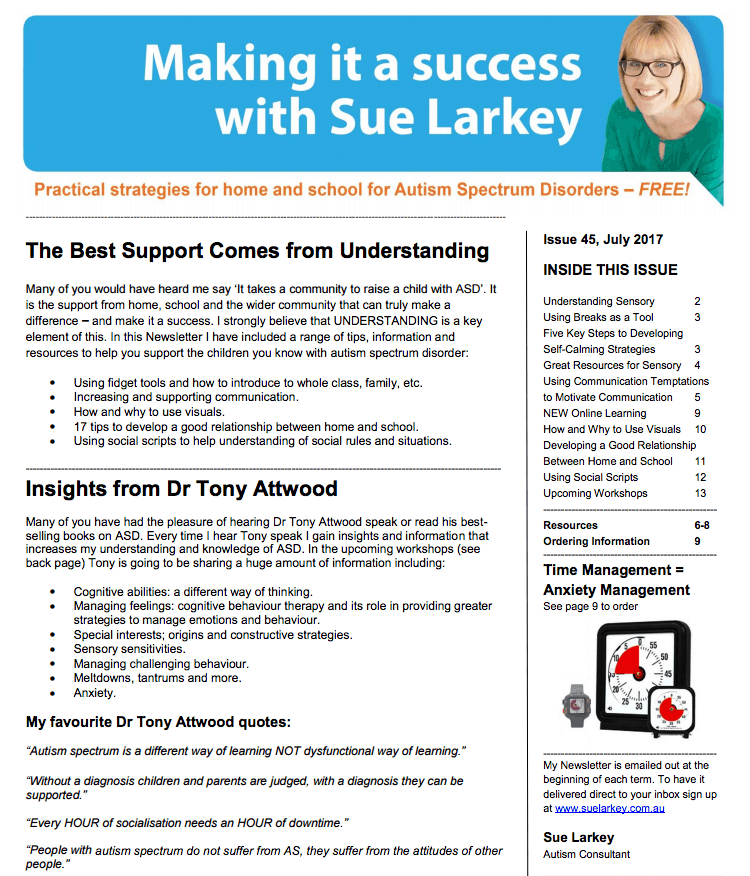
Many of you would have heard me say ‘It takes a community to raise a child with ASD’. It is the support from home, school and the wider community that can truly make a difference – and make it a success. I strongly believe that UNDERSTANDING is a key element of this. In this Newsletter I have included a range of tips, information and resources to help you support the children you know with autism spectrum disorder: Using fidget tools and how to introduce to whole class, family, etc. Increasing and supporting communication. How and why to use visuals. 17 tips to develop a good relationship between home and school. Using social scripts to help understanding of social rules and situations. Contents of Newsletter 13 pages Understanding Sensory 2 Using Breaks as a Tool 3 Five Key Steps to Developing Self-Calming Strategies 3 Great Resources for Sensory 4 Using Communication Temptations to Motivate Communication 5 NEW Online Learning 9 How and Why to Use Visuals 10 Developing a Good...
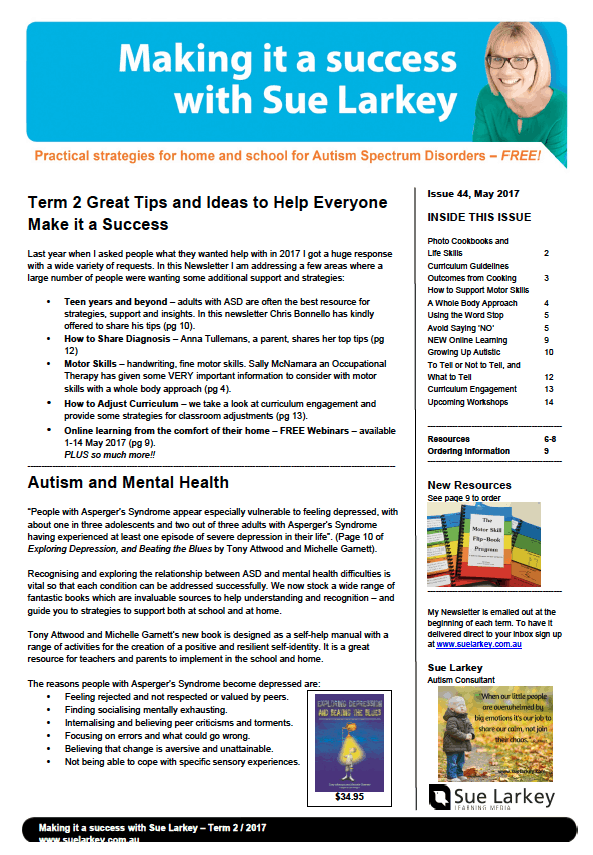
Complete Sue Larkey Term 2 2017 Newsletter
Last year when I asked people what they wanted help with in 2017 I got a huge response with a wide variety of requests. In this Newsletter I am addressing a few areas where a large number of people were wanting some additional support and strategies. To instantly view and download the Complete Term 2 Newsletter simply add your email address at the bottom of this page. INSIDE THIS ISSUE Photo Cookbooks and Life Skills 2 Curriculum Guidelines Outcomes from Cooking 3 How to Support Motor Skills A Whole Body Approach 4 Using the Word Stop 5 Avoid Saying ‘NO’ 5 NEW Online Learning 9 Growing Up Autistic 10 To Tell or Not to Tell, and What to Tell 12 Curriculum Engagement 13 Upcoming Workshops 14 PS: Morwell & Orange workshops only a few weeks away register now https://suelarkey.com.au/workshops/ Enter Your Email Address Below to view or download the whole newsletter: We respect your email privacy...
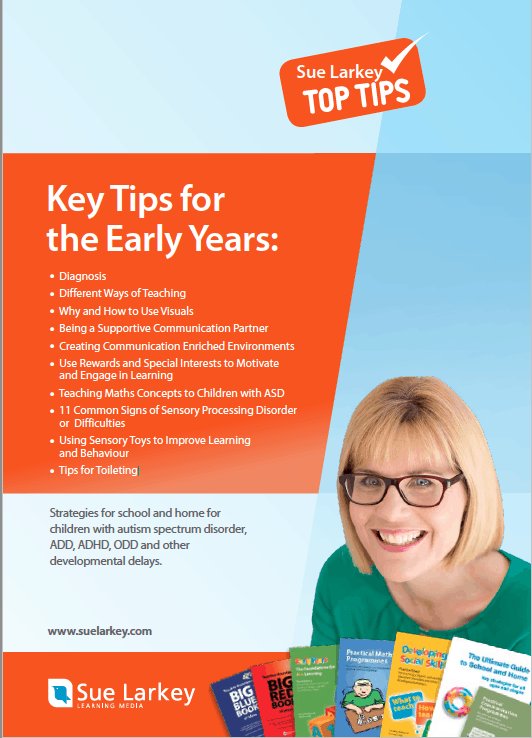
Key Tips for the Early Years
After many requests I have developed an Early Years E-Book aimed at the teachers, professionals and parents with younger children. Diagnosis Different Ways of Teaching Why and How to Use Visuals Being a Supportive Communication Partner Creating Communication Enriched Environments Use Rewards and Special Interests to Motivate and Engage in Learning Teaching Maths Concepts to Children with ASD 11 Common Signs of Sensory Processing Disorder or Difficulties Using Sensory Toys to Improve Learning and Behaviour Tips for Toileting BONUS #1 - How to Solve the BIGGEST Challenge Facing Teachers in the Early Years. BONUS #2 - How to Teach the Vital Foundation Skill of "Pointing". BONUS #3 - 4 Essential Methods to Teach a Child ANY New Skill. Strategies for school and home for children with autism spectrum disorder, ADD, ADHD, ODD and other developmental delays. To view and download the full ebook please add your email below this image....
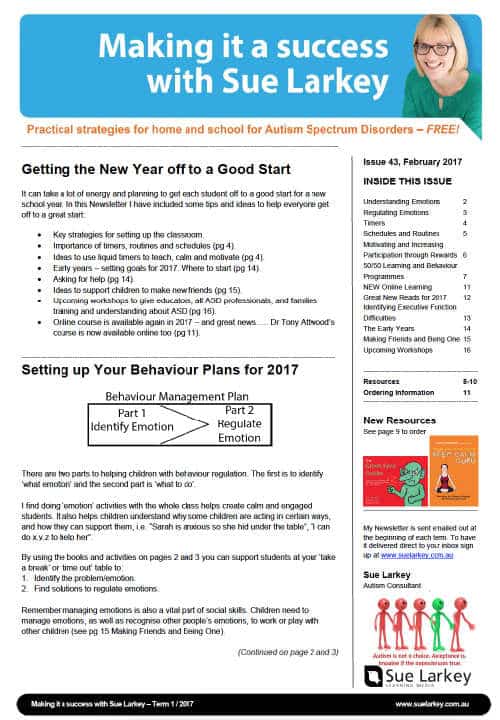
Complete Sue Larkey Term 1 2017 Newsletter
Getting the New Year off to a Good Start It can take a lot of energy and planning to get each student off to a good start for a new school year. In this Newsletter I have included some tips and ideas to help everyone get off to a great start: Key strategies for setting up the classroom. Importance of timers, routines and schedules (pg 4). Ideas to use liquid timers to teach, calm and motivate (pg 4). Early years – setting goals for 2017. Where to start (pg 14). Asking for help (pg 14). Ideas to support children to make new friends (pg 15). Upcoming workshops to give educators, all ASD professionals, and families training and understanding about ASD (pg 16). Online course is available again in 2017 – and great news….. Dr Tony Attwood’s course is now available online too (pg 11). Please add your email address to the form at the bottom of this page view and download the complete newsletter. Enter Your Email Address Below to view or download the whole newsletter:...
Are you looking for Key Strategies for Success? – R.T.S.
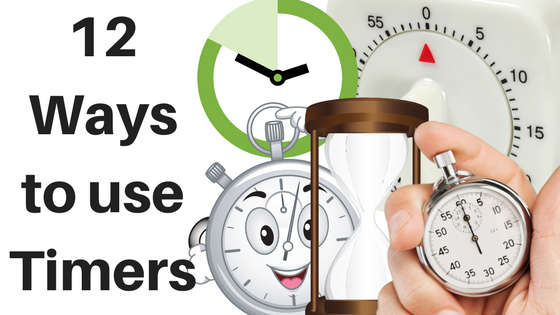
Using Timers = Reducing Anxiety = Improved Behaviour I often find your best strategies come when you reflect on yourself and try to put yourself in a child with an ASD’s shoes. Think how you use time, when it goes fast, when it drags, when it helps you plan, when it makes you anxious, when do you look at the time constantly. Have you ever lost your watch, how did it feel? Now let’s think of a child with an ASD and look at how they are using time. Timers can support students who have difficulty with executive functioning by helping them with self-monitoring, time management, prioritising, organisation, planning and impulse control (waiting). Time Timers and Portable Schedules with Digital Timers are a MUST for all children on the autism spectrum. These are invaluable at both home and school. Time Timers are specifically designed for use by those with an autism spectrum disorder. The notion of ‘time’ can be very difficult to understand for these children – particularly in the...
Top 10 Books For Professional Library & Why
With So Many Autism, Aspergers, ADHD and ODD Resources Available, Which are Essentials for a Professional and Why? There are so many resources now available to help teach children on the autism spectrum and it can be difficult to know which ones will be the most helpful – and this is a question I am most often asked. So here is my TOP 10 RECOMMENDED BOOKS for your Professional Library and WHY For those of you looking for support in understanding autism spectrum and the children you work with, as well as strategies for behaviour support, the top two books for every professional library I recommend. To Download PDF for these books >>> Top 10 Books for Professional Library & Order Form School/Organisations can ORDER ONLINE and select "ORDER ON APPROVAL" option to have the resources sent to them for review before payment. The Complete Guide to Asperger’s Syndrome | by...

Preparing up Your Classroom for Success – 19 Strategies
It can take a lot of energy and planning to get each student off to a good start for a new school year. When you may have one or two children in your class on the Autism Spectrum, this is even more important for their benefit and your other students. Getting the Classroom Structures right is a great start to having a sensational year. PLEASE PASS THIS INFORMATION ONTO ANY COLLEAGUE OR YOUR CHILD'S TEACHER AS IT'S CRAZY TO HAVE TO TAKE WEEKS OR A TERM TO WORK OUT THESE STRATEGIES MAKE A DIFFERENCE. Like so many of my blogs they are time savers for busy teachers, parents and professionals. Setting Up a Classroom for Students with ASD There are a number of specific areas that need to be taken into consideration when setting up a classroom for a student with ASD. The diagnostic criteria for ASD includes social, communication, sensory, behaviour, cognitive function and motor skills. Each child is individual and will need different accommodations depending on how the child is impacted...
