What Is AuDHD and RSD?
Understanding the Overlap Between Autism and ADHD
AuDHD classroom support strategies
Discussed in this Podcast:
✅ Use Visual Peer Modelling Before Asking AuDHD Students to Act – A Year 1 teacher described having two children visually demonstrate a task (e.g., taking out their book and sitting at the table) before asking the AuDHD student to do it. The student observes first, reducing demand and anxiety. The teacher reported that all children in the class benefited.
✅ Provide Both Routine AND Detail When Communicating Tasks – Students with autism may need to know ‘we have maths today.’ Students with AuDHD need both the subject AND what specifically they will be doing within that subject — e.g., ‘We have maths today and we’re doing multiplication with blocks.’ Tailor your communication to include both elements.
✅ Always Start With a Sensory Assessment Before Behaviour Strategies – Laura described being called into a primary school to provide behaviour strategies, but instead identified that the student was severely dysregulated from a sensory perspective — being told off for fidgeting and calling out. The recommendation: complete a sensory assessment before any behaviour plan is introduced.
✅ Build in Proactive, Educator-Initiated Movement Breaks – Rather than waiting for a student to ask for a break (which can be socially difficult), educators can notice signs of dysregulation early and proactively offer a movement break. This avoids the behaviour escalation entirely and serves a preventative purpose.
✅ Use Visuals for ADHD Students, Not Just Autistic Students – The episode highlights that visuals are widely understood as essential for autism support, but are equally important for AuDHD learners. Educators should apply visual schedules, task breakdowns, and finished product examples for ALL neurodivergent students, including those with an ADHD-only diagnosis.
✅ Teach the ‘Take the Thought to Court’ Strategy for RSD – When a student believes a teacher or peer is thinking negatively about them, prompt them to ask: ‘Where is the evidence?’ Help them investigate alternative explanations. For example: ‘What else could the teacher have been thinking about when they gave you that look?’ This helps students challenge distorted thinking patterns driven by Rejection Sensitivity Dysphoria.
✅ Ask Students to Generate Alternative Explanations for Social Situations – A mother of an AuDHD child would ask her son: ‘Finn, what else could those people have been thinking?’ This technique helps students with RSD move away from catastrophic interpretations of social interactions and build more balanced thinking habits over time.
✅ Set Personalised Academic Goals With Students AND Parents Together – To counter perfectionism and ‘why bother syndrome,’ educators can sit down with parents at the start of the year to agree on subject-specific targets — e.g., 60% in English, 80% in History — so students understand their parents are not expecting perfection. This reduces the fear of failure that can lead to task avoidance.
✅ Use Kinesthetic, Hands-On Learning as a Sensory and Engagement Strategy – Laura emphasised: ‘Involve me and I learn.’ For AuDHD students, physically doing a task rather than just being told or shown addresses both the sensory-kinesthetic need and the engagement challenge. Incorporate hands-on demonstrations, manipulation of objects, and physical involvement into lessons.
✅ Label RSD for Students When They Are Ready to Understand It – Laura describes a young person who said: ‘I wish someone had told me about this when I was younger.’ Teaching older students about Rejection Sensitivity Dysphoria — explaining that ‘your brain is tricking you’ — gives them a framework to understand their own emotional responses and apply self-regulation strategies.
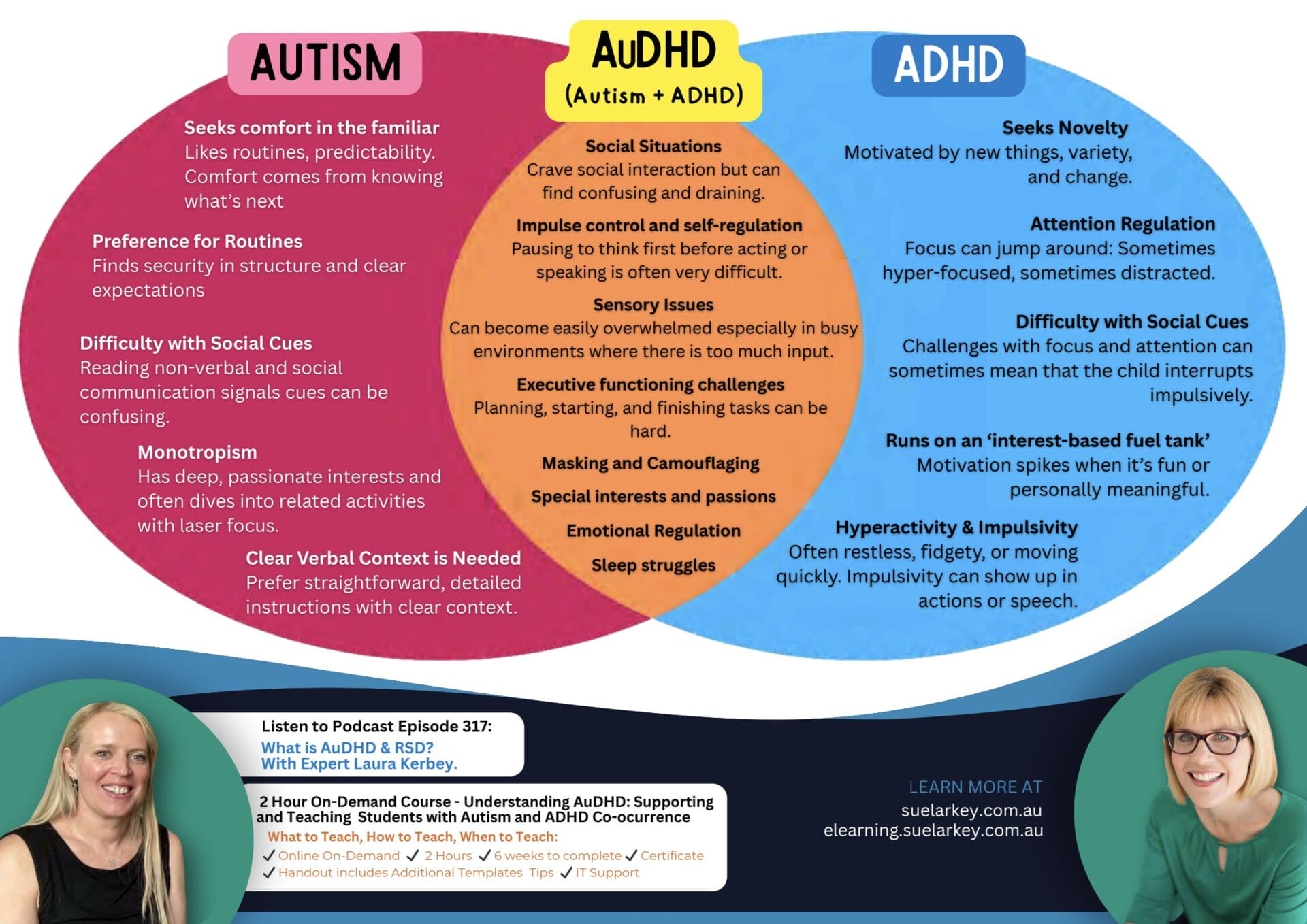
WHAT IS AuDHD & RSD?
FREE AuDHD Poster & RESOURCES
Ever wondered about the Autism-ADHD combined – AuDHD?
Have you heard of RSD?
This free pack includes handy visual posters that explain AuDHD & RSD
These easy-to-understand resources explain what AuDHD & RSD are. Great to printout and put up in your staffroom
Grab your free copy now!

5 Challenges and Solutions
Student contradictions confuse teachers
Understanding AuDHD means recognizing “different days when my brain needs different things” – flexibility is key
Traditional autism strategies aren’t working
Recognizing 50-70% have both conditions requires combining approaches – “variety within routine” for math lessons
Student assumes everyone hates them
“Take the thought to court” technique – asking “where is the evidence?” to challenge distorted thinking
Class clown behavior persists despite consequences
Recognizing RSD drives peer approval seeking – “their peers wanting them to do something is far bigger than the principal telling them off”
Student devastated by near-perfect grades
Understanding RSD perfectionism – collaborate with parents on realistic expectations to reduce pressure
UNDERSTANDING AuDHD: Teaching & Supporting Students with Autism and ADHD Co-occurrence
✅ 2 Hours, 8 Lessons
✅ 6 Weeks to Complete 🎁 Bonus 6 Months Access (available until 28 Oct 25)
✅ Certificate of Completion
✅ Lesson Transcripts
 2 Hours
 Certificate
$149
recommended courses
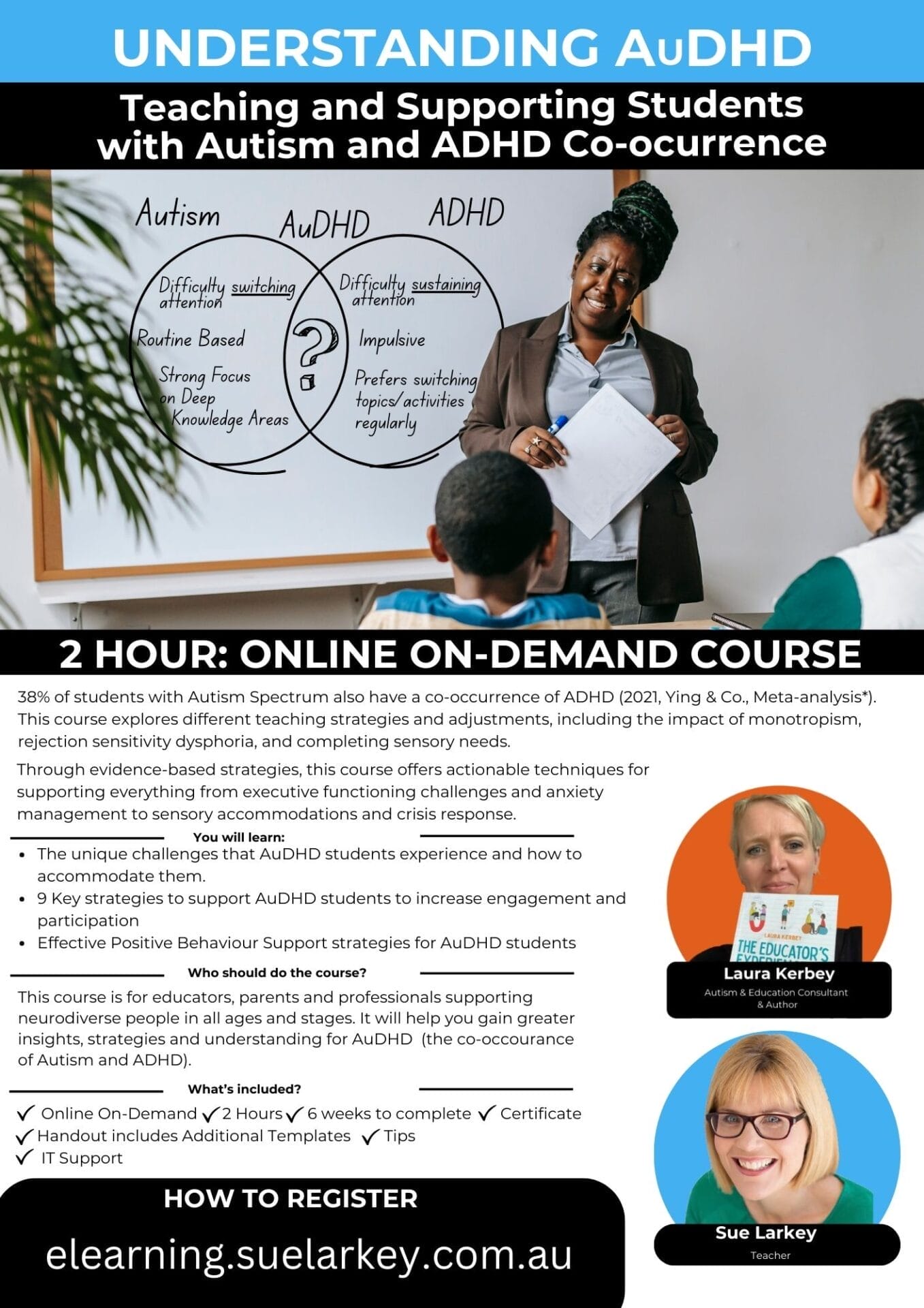
Understanding AuDHD:
Teaching and Supporting Students with Autism and ADHD Co-ocurrences

Executive Functioning Training
Educators Guide to Executive Functioning – Why it impacts Learning and Behaviour & What to do
RECOMMENDED PODCASTS
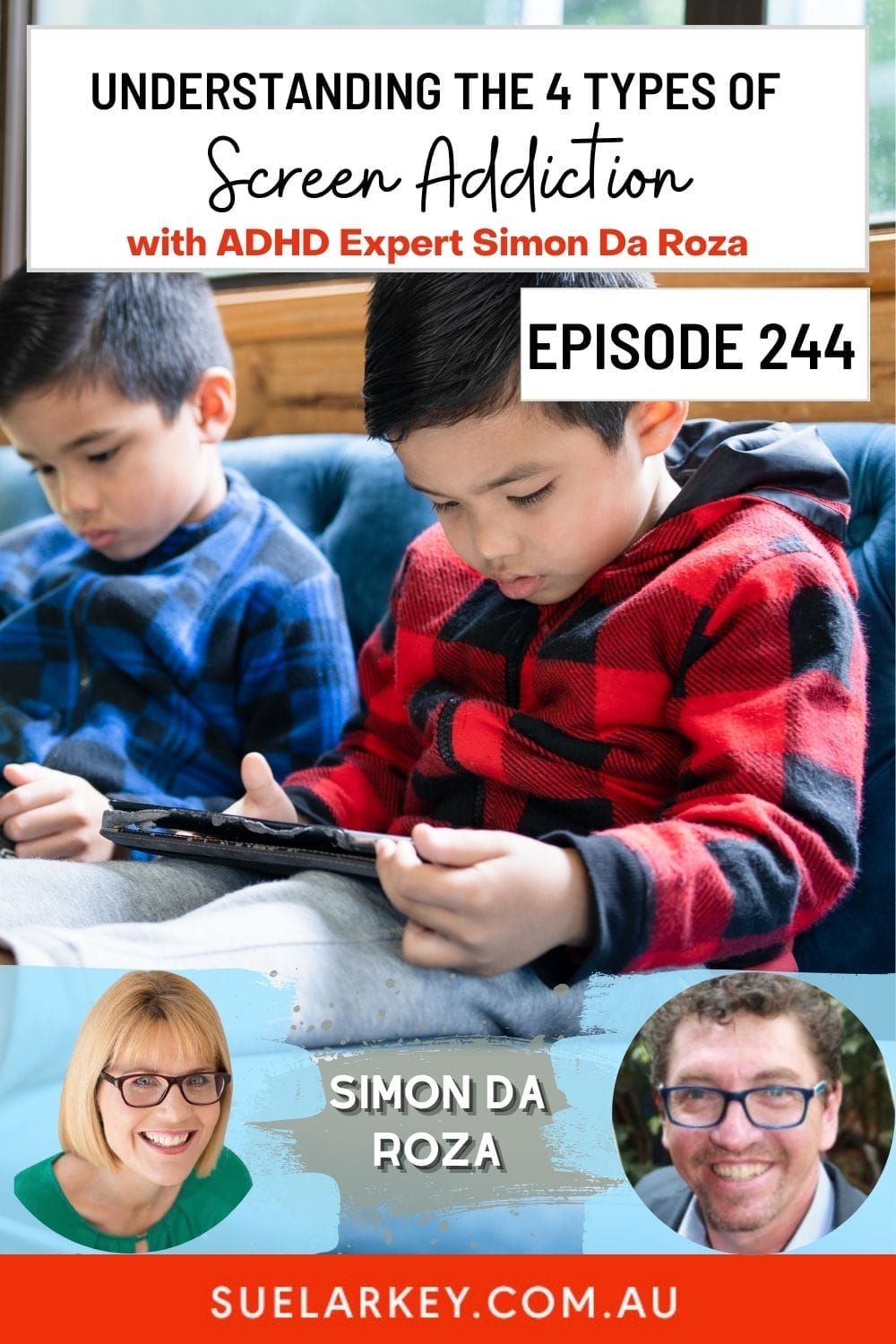
Episode 244:
Understanding the 4 Types of Screen Addiction with ADHD Expert Simon Da Roza

Episode 229:
Dr. Norrine Russell’s Insights into ADHD & AS

Episode 291: Understanding PDA & ODD in the Classroom: An Educators Guide
RECOMMENDED PRODUCTS
-

Time Timer – 20cm Medium
$65.00 -

Time Timer – 7.6cm Small
$50.00 -

Portable Schedule with Digital Timer
$24.95 -
Developing Social Skills
$39.95 -

Time Timer PLUS
$80.00 -

The Ultimate Guide to School and Home
$44.95 -

Step by Step Help for Children with ADHD
$45.95 -

Organize Your ADD/ADHD Child
$42.95 -

Executive Function Dysfunction
$48.95 -

Autism and Everyday Executive Function
$65.95 -

Time Timer MOD – Charcoal Colour
$60.00 -

Sue Larkey’s MEGA BOOK of Timesavers, Tips & Strategies for Busy and Complex Classrooms
$49.95 -

Time Timer – 20cm (Medium) Classroom Set (Set of 3)
$245.00 -

The (Slightly Distracted) Woman’s Guide to Living with an Adult ADHD Diagnosis
$39.82



 Sorry we no longer ship items outside Australia. Please consider the digital versions of Sue’s Books –