How to Have the Hard Conversation:
8 Steps for Educators Starting the Diagnosis Conversation
Talking to Parents Diagnosis
Discussed in this Podcast:
✅ Choose the meeting location carefully. Avoid the principal’s office. Meet parents in a relaxed setting like the classroom, during yard duty, or even casually at a community spot (Sue shares that some of her best conversations happened at supermarkets).
✅ Use the 4:1 ratio – four positives to one negative. Before raising any concern, prepare at least two to three genuine positive things about the child. Emily witnessed a meeting where four staff members could not name a single strength of a child with ADHD – and the parents left defeated.
✅ Start every meeting with a reflection exercise. Have everyone – parents, teachers, aides – sit quietly and write down three things going well and three biggest challenges, then share the positives first. 4. Use an “appointments” system for partner work. For children who are always picked last, pre-assign “appointments” (partners) each morning so the child knows who they’ll be working with, reducing end-of day meltdowns from social rejection.
✅ Ask parents about behaviour beyond the home. When parents say they don’t see concerning behaviour at home, ask about birthday parties, playgrounds, restaurants, and supermarkets. Parents may have stopped going to those places – which is itself a red flag.
✅ Organise notes under three headings: Social, Emotional, and Academic. Rather than using generic checklists, create individualised observation notes under these three categories with date- and time stamped examples.
✅ Keep a referral list handy. Build a list of psychologists, paediatricians, and OTs from positive past interactions or parent recommendations. When you suggest an assessment, parents will immediately ask “Who should I go to?” – be ready with names.
✅ Create a written email trail after every meeting. Document what was discussed, what each person’s action items are, and schedule the next meeting. If a parent declines assessment, document that too – it protects everyone.
✅ Organise professional interpreters for multilingual families. Don’t allow family members (including older siblings) to interpret – they may filter or edit questions. One educator learned this the hard way when a parent was editing questions for their own parent.
✅ Never suggest medication. Emily reports that 8 out of 10 meetings she attends, teachers suggest medication. This is neither appropriate nor professional – even for a clinical psychologist. That is the paediatrician’s role only.
Make sure you listen to this Podcast as each step is discussed in detail including mistakes to avoid and the power of diagnosis.
8 Steps to Talking for Families about pursuing a diagnosis

What are the “Red Flags” (indicators) that educators should look for in children?
These are the 3 Areas to keep an eye on.
Social development and the power of diagnosis
- Are they playing well with others?
- Do they struggle with tasks that the other children appear to manage easily?
- Are they easily distractable to a degree that does not seem age appropriate?
- Have complaints been made about the child by other children or teachers?
emotional development and successful diagnosis
- Does the child appear anxious or stressed?
- How does the child cope with transitions or changes to their routine?
- Is the child able to bounce back after being reprimanded or does it ruin their day?
- How does the child cope with making mistakes?
Academic achievement for students
- Is there a specific area that the child appears to be struggling in?
- Could the child benefit from additional supports?
- Does the child take up more of the teacher aide’s time than other children?
why unlock the power of diagnosis?
- Understanding your child better
- Access to additional supports and funding
- Tailored therapeutic options
- Help the child to understand themselves
- Teachers discussing diagnosis
Information about Emily hanlon
RECOMMENDED COURSES
Understanding Autism Spectrum Disorder: Knowledge to Improve Student Learning, Participation and Outcomes
Practical Behaviour Strategies for Every Classroom: The Ultimate Classroom Behaviour Guide for Neurodiverse Students (AS, ADHD, ODD, PDA)
RELEVANT RESOURSES

EPISODE 110:
Understanding Autism: Common Confusions and Misunderstandings – with Psychologist Emily Hanlon
EPISODE 150:
Sharing Diagnosis with Family & Friends – Who, Why & How

EPISODE 182:
Sue Larkey’s Expert Series: The Fabulous New Screening Tools to Get an Earlier Diagnosis with Professor Barbaro
RELEVANT RESOURSES
-

Can I Tell You About Asperger Syndrome?
$31.95 -

Can I Tell You About OCD?
$31.95 -

Can I Tell You About Autism?
$31.95 -

Can I Tell You About Anxiety?
$31.95 -

Can I Tell You About Dyspraxia?
$31.95 -

Can I Tell You About ADHD?
$31.95 -

Can I Tell You About Selective Mutism
$31.95 -

Can I tell you about Pathological Demand Avoidance syndrome?
$31.95

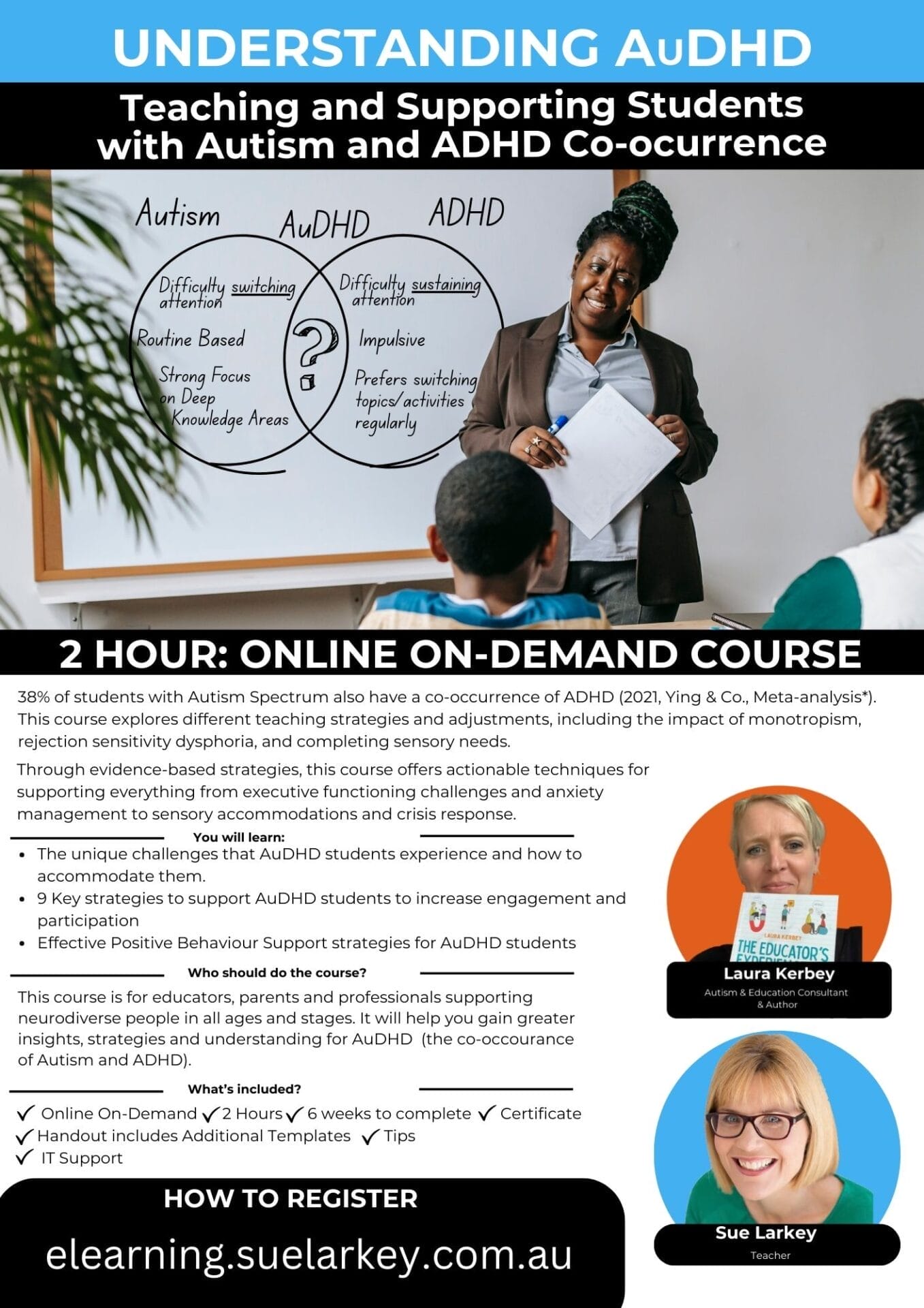
UNDERSTANDING AuDHD: Teaching & Supporting Students with Autism and ADHD Co-occurrence
✅ 2 Hours, 8 Lessons
✅ 6 Weeks to Complete
✅ Certificate of Completion
✅ Lesson Transcripts
 2 Hours
 Certificate
$149


 Sorry we no longer ship items outside Australia. Please consider the digital versions of Sue’s Books –